The forefront of reform and opening up. In 2020, it was invested by the mainland government to build a new LCD production line in Huaihua, Hunan. The company's main products are Segment code screen TN /HTN /STN /FSTN ,LED backlight, COG lattice LCD module, COB standard module, OLED standard display screen and TFT color screen. The company has 2 segment code screen production lines, 4 backlight production lines, 5 FOG binding lines and 10 assembly production lines. The factory buildings in Shenzhen and Hunan have a production area of 10,000 sqm and 500 employees. The company's business philosophy 'create value for clients '.The production sites of the factory are respectively located in Huaihua, Guangdong, Shenzhen and Hunan, with one LCD segment code screen production line, four backlight production lines, five FOG binding lines and ten module assembly production lines. The total production area of factories in Shenzhen and Hunan is 10,000 + ㎡, with 100~10,000 level constant temperature and humidity dust-free workshops, with more than 500 front-line employees, 28 technicians and 9 sales engineers.
Why Choose Us
Production Line
The company has 1 LCD segment code screen production line, 4 backlight production lines, 5 FOG binding lines and 10 module assembly production lines. Perfect automation equipment technology, stable shipment, daily production of 30000 +/piece.
Production Experience
More than ten years of production experience since its establishment, at the same time, strengthen the training of production management personnel, front-line employees, business and sales teams to ensure smooth customer communication, high cooperation and accurate delivery time.
Our certification
The factory has passed SIO9001 quality system certification and ROHS certification.
After-sales
The company has offices in many places (Shenzhen, Ningbo, Zhengzhou) with perfect after-sales service mechanism, providing technical support before and after sales, and arranging engineers nearby to provide on-site service.

"0802COB LCD module" is a common LCD module with 8 rows and 2 columns of character display capability. It uses COB (Chip on Board) technology to directly package the driver chip on the module backplane, so it has a compact design and stable performance. 0802A character LCD module is a dot matrix LCD module specially used to display letters, digital elements, symbols, etc.

1601 LCD module is a miniaturized LCD display device, which is widely used in various electronic products, such as smart watches, stage light controllers, screw machines, portable electronic devices, etc. It adopts a 16-character × 1-line display structure, has high integration and low power consumption, and is suitable for scenes that need to display short information. It usually contains components such as LCD panel, drive circuit and controller chip.

Alphanumeric 1602A LCD Display
1602 LCD is a common character LCD module, which is widely used in various electronic devices and embedded systems. Its name "1602" means that the display can display 16 columns and 2 rows of characters. 1602 LCD module is widely used in various electronic devices and embedded systems for its simple, practical, stable and reliable characteristics. It provides users with clear and reliable text information display function and is an important part of electronic product design.

1604 LCD module is a highly integrated LCD display module, usually used in devices that need to display more characters and information. It uses COB (Chip-on-Board) packaging technology to integrate the LCD display, drive circuit and control logic on a circuit board, with good display effect, integration and stability..

The 2002 LCD screen is a common liquid crystal display module, which is usually used as a display device in electronic products. The "2002" in its name refers to its pixel resolution of 20 columns × 2 rows. 2002A LCM is commonly used in various consumer electronic products and embedded systems, such as electronic blood pressure monitors, thermometers, electronic clocks, etc., and is popular because of its simplicity, reliability and moderate cost.

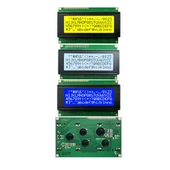
2004LCD Moudle is a liquid crystal display module based on COB (Chip-on-Board) technology. The "2004" in its name refers to its pixel resolution of 20 columns × 4 rows. This type of screen is widely used in various electronic devices and embedded systems, and is favored for its high integration, strong stability and good display effect.

LCD Display 128x128 Graphic LCD
128128COG LCD screen module is a high-performance LCD screen module, which is widely used in various electronic products. It has a resolution of 128x128, adopts COG (Chip on Glass) packaging technology, and is an integrated module consisting of a 128x128 pixel LCD screen and a driver chip. It has high-quality display effects and stable and reliable performance.

240*160 Monochrome LCD Spi Display
The 240160COG LCD dot matrix screen is a small LCD screen with a resolution of 240x160 pixels, which has the ability to display images and texts in various electronic devices. It adopts COG (Chip on Glass) technology, which achieves compact design and high-quality display effects by integrating the driver chip on the glass substrate.

12232 LCD dot matrix screen is a common LCD screen, which is characterized by a pixel matrix structure of 122 columns and 32 rows, capable of displaying images and text. It is widely used in various electronic devices, such as calculators, electronic clocks, thermometers, electronic scales, etc.
What Is 0.96 Tft Display
TFT stands for Thin Film Transistor. TFT is not just a display technology per se, but a very special type of transistor to improve image quality. It is most often used in conjunction with LCD displays.Therefore, a TFT display is an active matrix display where each display pixel is individually illuminated. TFT displays are made using large sheets of transistors, each of which is independently controlled.
Benefits of 0.96 Tft Display
The display quality of the TFT display is high
Because every point of the TFT display screen keeps the color and brightness after receiving the signal, and emits constant light, unlike the cathode ray tube display (CRT) that needs to constantly refresh the bright spot. Therefore, the LCD panel TFT has high image quality and will never flicker, minimizing eye fatigue.
The power consumption of the TFT display is small
The traditional display screen is composed of many circuits. When these circuits drive the cathode-ray picture tube to work, they need to consume a lot of power, and as the volume increases, the power consumed by the internal circuit will definitely increase. In contrast, the power consumption of the TFT liquid crystal display screen is mainly consumed on its internal electrodes and driver IC, so the power consumption is much smaller than that of traditional displays.
The picture effect of the TFT display is good
Compared with traditional display screens, the LCD panel TFT uses a purely flat glass plate from the beginning, and the display effect is flat and right-angled, giving people a refreshing feeling. Moreover, LCD monitors are easier to achieve high resolution on small screens. For example, a 17-inch LCD monitor can achieve a resolution of 1280×1024, while a 18-inch CRT color display usually uses a resolution of 1280×1024 or more which is not completely satisfactory.
Twisted Nematic (TN) TFT LCD Displays
Twisted Nematic (TN) TFT LCD displays are among the oldest and most widely used types of TFT panels. They feature a simple structure consisting of liquid crystal molecules twisted between two glass substrates, controlled by thin-film transistors. TN panels offer fast response times, making them ideal for applications requiring smooth motion, such as gaming monitors and multimedia playback. However, TN displays are often criticized for their limited viewing angles and inferior color reproduction compared to other TFT LCD technologies.
In-Plane Switching (IPS) TFT LCD Displays
In-Plane Switching (IPS) TFT LCD displays are known for their superior color accuracy, wide viewing angles, and excellent image quality. IPS panels employ a different liquid crystal alignment technique that allows light to pass through the display more evenly, resulting in vibrant colors and consistent brightness from various viewing angles. IPS displays are commonly found in high-end monitors, laptops, tablets, and smartphones, where color accuracy and viewing experience are paramount.
Vertical Alignment (VA) TFT LCD Displays
Vertical Alignment (VA) TFT LCD displays strike a balance between the fast response times of TN panels and the superior color reproduction of IPS panels. VA panels feature liquid crystal molecules aligned perpendicular to the glass substrates, resulting in deeper blacks and higher contrast ratios compared to TN and IPS displays. VA displays offer good color accuracy and wide viewing angles, making them suitable for multimedia consumption, graphic design, and professional applications.
Super Twisted Nematic (STN) TFT LCD Displays
Super Twisted Nematic (STN) TFT LCD displays are an advanced version of TN panels, offering improved contrast ratios and wider viewing angles. STN panels feature a higher degree of liquid crystal twisting, resulting in enhanced grayscale performance and better image quality. While STN displays are less common in modern devices due to the emergence of IPS and VA technologies, they are still used in applications where cost-effectiveness and moderate performance are acceptable.
Detailed display of 0.96 TFT display


The Application of 0.96 Tft display in Automotive Navigation Systems
With the prevalence of smartphones and mobile internet, automotive navigation systems have become standard in modern driving. 0.96 Tft Display provide drivers with clear and readable maps and real-time traffic information, making it easier for them to reach their destinations. Additionally, 0.96 Tft Display can be integrated with voice assistants to enable voice-guided navigation, further enhancing driving safety.
The Application of 0.96 Tft Display in Automotive Instrument Clusters
Traditional automotive instrument clusters are gradually being replaced by 0.96 Tft Display. These displays can show key information such as vehicle speed, fuel consumption, and mileage in real-time, allowing drivers to focus more on the road. At the same time, 0.96 Tft Display can be personalized based on driver preferences, displaying additional useful information such as navigation prompts and music playback.
The Application of 0.96 Tft display in In-Car Entertainment Systems
With the advancement of the automotive industry, in-car entertainment systems have become a focal point for consumers. 0.96 Tft Display in this context provide passengers with a wide range of entertainment options, such as watching movies and playing games. Furthermore, 0.96 Tft Display can seamlessly connect with smartphones, allowing passengers to enjoy their favorite music and video content anytime, anywhere.
The Application of 0.96 Tft display in Automotive Safety Systems
Automotive safety systems represent another important application area for 0.96 Tft display in the automotive industry. By connecting the displays with various vehicle sensors, drivers can have real-time awareness of the vehicle's operating condition and promptly identify potential safety hazards. Additionally, 0.96 Tft display can be combined with rear-view cameras to assist drivers in accurately assessing the situation behind the vehicle, reducing the risk of accidents during reversing.
Features of TFT Displays
Excellent Colour Display
Top notch colour contrast, clarity, and brightness settings that can be adjusted to accommodate specific application requirements.
TFT displays can have either resistive or capacitive touch panels
Resistive is usually the standard because it comes at a lower price point, but you can also opt for capacitive which is compatible with most modern smartphones and other devices.
Extended Half-Life
TFT displays boast a much higher half-life than their LED counterparts and they also come in a variety of size configurations that can impact the device's half-life depending on usage and other factors.
TFT displays offer exceptional aspect ratio control
Aspect ratio control contributes to better image clarity and quality by mapping out the number of pixels that are in the source image compared to the resolution pixels on the screen.
Monitor ghosting doesn't occur on TFT displays
This is when a moving image or object has blurry pixels following it across the screen, resembling a ghost.
TFT displays are incredibly versatile
The offer a number of different interface options that are compatible with various devices and accommodate the technical capabilities of all users.
Battery life and life expectancy
What is going to be the length of ongoing use or duration of your project? Based on this information, you need to pick a solution that can last a long time – all the while maintaining high-quality use.
Accuracy in touch and type of touch technology
What kind of activities will your device support? For example, if it's intended for extended outdoor use, then a projected capacitive touchscreen is a better choice – it's more precise and accurate. Touch accuracy might be more important for commercial and industrial applications.
Response time
TFT displays usually come with faster response times and more accurate touch performance. But make sure that the one you choose delivers the right user experience.
Image clarity
Some TFT displays include infrared touch screens, while others are layered. Pick the former if your application is going to be used in poor lighting conditions or for outdoor and or industrial use. There will be no overlay or obstructions to light emittance.
The environment of your application
When picking a TFT-LCD display for outdoor or industrial applications, pick one that can withstand different elements such as dust, wind, dirt, sunlight, and moisture.
1. First, we must confirm with the customer where special design is needed according to the drawings sent by the customer.
2. Then we designed the display screen scheme for the whole machine according to the customer's requirements. After continuous communication between us, we sent the drawing of the TFT display screen assembly to the customer for confirmation.
3. After the customer sees our drawings and is confirmed to be correct, they will formally enter the project approval stage to conduct sample research and development. After the customer receives the TFT display screen sample, they will debug with the whole machine, and enter the next small batch stage after one pass.

Avoid Direct Sunlight
Exposure to direct sunlight for prolonged periods can cause damage to your 0.96 TFT display. The intense heat and UV rays can lead to discoloration, image burn-in, or even permanent damage. To protect your display, position it away from windows or use curtains or blinds to block direct sunlight.
Adjusting Brightness and Contrast
Adjusting the brightness and contrast levels of your 0.96 TFT display is not only essential for optimal viewing experience but also helps to extend its lifespan. Use the display settings to find the right balance of brightness and contrast that suits your needs. Avoid setting the brightness level too high, as it can accelerate the aging process of the display.
Power Management
Proper power management is crucial for maintaining your 0.96 TFT display. Avoid leaving your display on for extended periods when not in use. Set your computer or device to automatically enter sleep mode or turn off the display after a certain period of inactivity. This not only conserves energy but also helps to extend the lifespan of your display.
Avoid Screen Burn-in
Screen burn-in is a common issue that can occur with 0.96 TFT displays, especially if static images or logos are displayed for long periods. To prevent screen burn-in, avoid displaying static images at high brightness levels for prolonged periods. Additionally, use screensavers or power management features that activate after a certain period of inactivity.
Use a Screen Protector
Investing in a high-quality screen protector can provide an extra layer of protection for your 0.96 TFT display. Screen protectors are designed to shield the screen from scratches, dust, and fingerprints. Make sure to choose a screen protector specifically designed for 0.96 TFT displays to ensure optimal clarity and touch sensitivity.
Avoid Touching the Screen
While 0.96 TFT displays are often touch-sensitive, it is important to avoid touching the screen unnecessarily. Touching the screen with dirty hands or using sharp objects can cause scratches or damage the protective coating. If you need to interact with the screen, use a stylus or a clean, soft cloth to minimize contact.
Our Certificate


Our Factory


FAQ
Hot Tags: 0.96 tft display, China 0.96 tft display manufacturers, suppliers, factory, reflective lcd modules, HTN LCD Display, 7 Segement LED Graphics, Reflective Monochromatic FSTN LCD, 40x2 LCD Display, 16 4 LCD Character Display