


LCD Screen


Types of LCD Screen
Reflective LCD Screen
Reflective LCD screen is a common digital display.Positive LCD display is favored by users with its clear display effect, low power consumption, high reliability and other characteristics.
Negtive LCD
Negative LCD display is a special type of LCD display technology. In most cases, he needs to use the backlight to use it to display it.
TN LCD Panel
TN LCD (Twisted Nematic Liquid Crystal Display) is a common LCD technology, viewing angle range: 70~90°, driving voltage: 3~5V.In the negative display mode, it is usually made of dark green.
HTN LCD Display
The HTN LCD display are based on twisted nematic (TN) liquid crystal technology, where liquid crystal molecules twist under the action of an electric field, changing the direction of light propagation to achieve display effects.
STN(FSTN) LCD Display
The STN LCD display is a common liquid crystal display technology, which is widely used in various electronic devices.
VA LCD Display
VA LCD (Vertical Alignment Liquid Crystal Display) is a LCD display technology with unique characteristics and advantages.
Your Leading LCD Screen Manufacturer
Cheng Xin Optoelectronics LTD. is a manufacturer that provides a wide range of display products for various industries. The company was established in 2014 and specializes in the development and manufacture of LCD screen. It offers a wide range of products, including reflective LCD screen, two-digit seven segment LED, three-digit 7 segment LED, VA LCD display。
Clocks: Used in displays in digital wall clocks.
Cameras: Used in digital cameras for displaying images.
Television: Has a major application in LCD TFT screens.
Computer monitors: Most of the modern world computer monitors are made of LCDs.
Instrument panels: All the lab instuments uses LCD screens for display.
Aircraft cockpit displays: Cockpit display panels of pilots are usually LCDs.
Video players
Such screens are very popular in video game parlours and consoles.
Watches
All the digital wrist watches uses LCD screen for displaying time.
Calculators
Calculator display screens are LCD screens.
The Basic Components of an LCD Screen
Liquid Crystal Layer
This layer is made up of numerous tiny cells filled with liquid crystals.
Backlight
This is the light source for the screen.
Color Filters
These filters add color to the images created by the liquid crystal layer.
Substrate Preparation: The first step in manufacturing an LCD screen involves preparing the glass substrates.
Thin Film Transistors (TFT) Fabrication: The array substrate is coated with a layer of transparent conductive material, usually indium tin oxide (ITO).
Color Filter Fabrication: The color filter substrate is coated with a black matrix to define the boundaries of each pixel. Then, red, green, and blue color filters are applied to their respective pixel areas.
Liquid Crystal Alignment: Both the array substrate and the color filter substrate undergo a liquid crystal alignment process.
Liquid Crystal Injection and Sealing: The array substrate and color filter substrate are aligned facing each other, with a narrow gap between them.
Polarizer Attachment: Polarizers are applied to the outer surfaces of the LCD screen to control the polarization of light passing through the liquid crystal layer.
Testing and Inspection: After the LCD screen assembly, a series of rigorous tests and inspections are performed to ensure the quality and reliability of the screens.
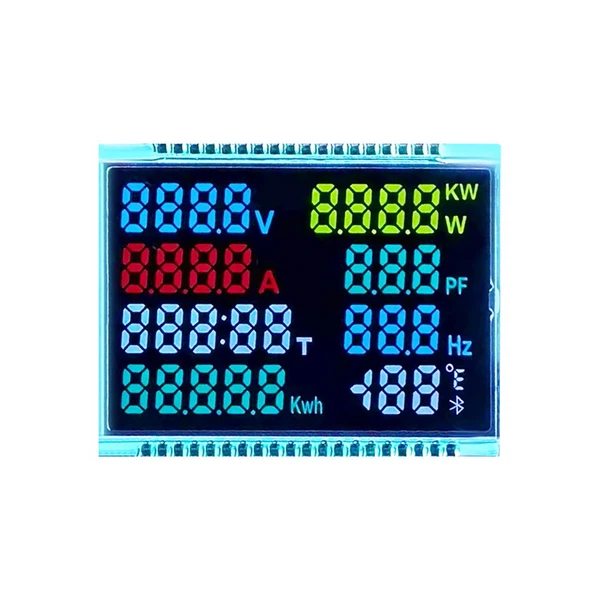
Features of LCD screen

LCD screens broadly refer to all LCD screens, and can be manufactured in various configurations, including TN, STN, FSTN, TFT, and IPS. We are referring to 7-segment LCDs.
Environmentally robust: Some LCDs can operate stably in temperatures ranging from -30°C to 80°C. Based on operating temperature, our industry categorizes them into industrial-grade and standard-grade, distinguishing between those suitable for use in harsh environments and those suitable for everyday use.
Flexible Usage: Reflective LCD screens typically don't use LED backlights. When using LED backlights, they can be configured as transmissive, reflective, or semi-transmissive.
Safe and Environmentally Friendly: Compared to CRTs, LCDs don't flicker due to insufficient refresh rates, making them more eye-friendly. 7-segment LCDs are self-luminous, making them energy-efficient and environmentally friendly.
Adjustable Viewing Angle: TN, HTN, STN, FSTN, VA, and IPS technologies determine different viewing angles.
Other Services
Delivery Method
Express (DHL / FEDEX / UPS) , Air , Sea , etc. Depending on customers' cost or time requirements, we ship by the best one.
01
Payment Terms
Our usually payment term is T/T. Others can be negotiated.
02
Fast Delivery
The product will be shipped within 48 hours after order confirmation.
03
Warranty
With 120 days warranty and returns and exchanges supported.
04
MOQ
Our standard products MOQ is 500 pcs, customized products have MOQ requirement, please contact our sales team for detailed information.
05
FAQ
As one of the most professional LCD screen manufacturers and suppliers in China, we're featured by quality products and low price. Please feel free to wholesale cheap LCD screen made in China here from our factory. Contact us for customized service.