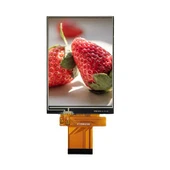
Our daily mobile phones, learning machines, and televisions are all equipped with TFT LCD screens. So, what is the manufacturing process for TFT LCDs?
The typical process flow is as follows: 1. Substrate preparation – 2. ITO (transparent conductive film) coating – 3. TFT array fabrication – 4. Liquid crystal injection – 5. Driver circuit fabrication – 6. Testing – 7. Polarizer lamination – 8. Assembly and debugging – 9. Package testing.
The biggest difference between TFT LCDs and other screen types is the fabrication of the TFT array, which directly determines the display quality. TFTs are thin-film transistors, and each liquid crystal molecule precisely controls a thin-film transistor, which directly leads to a more complex driver circuit than other products.
Using IC packaging technology, the driver chip is connected to the TFT array to form a complete circuit.
The driver circuit controls the display of each pixel, adjusts brightness and color, and ensures that the displayed content switches normally during use. Polarizer films are applied to both sides of the LCD screen. At this point, a complete TFT LCD screen is complete.
A TFT LCD screen is assembled with a backlight module, housing, and other components. A backlight source (such as LEDs) is installed behind the display panel to provide the necessary illumination.
The LCD's color, brightness, contrast, and other parameters are carefully tuned to ensure optimal display quality.
A TFT LCD is a type of display module. For more information on LCD screens, please contact us!